Dispatch 08 · The Dialogues: The Spark is Still There
In Focus: Ivana Tarraza on the gentle rebellion of living from the gut.
Friday, June 26th - 6min read - Jose Martinez Editor-in-Chief
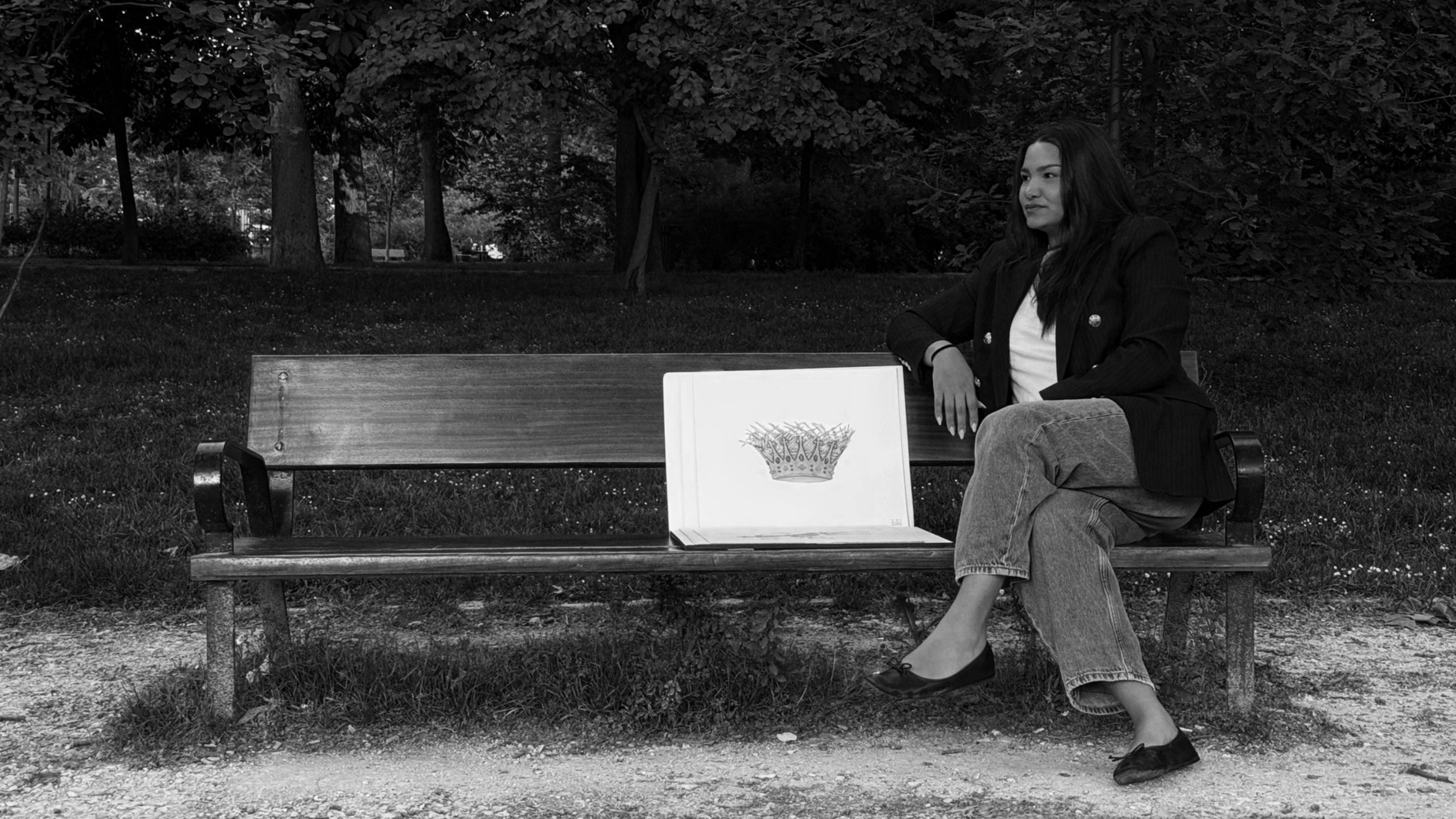
Ivana Tarraza
https://ivanatarraza.com
I. The Dust on the Lens
It has been a while since the ink dried on this website. The last time I sat down to write for The Aperture Collective, we were talking about watches—the Audemars Piguet x Swatch crossover. After that, the site went quiet.
It didn’t go quiet for a lack of things happening, but rather because of the exact opposite: life got loud. When you are busy navigating the demands of the professional world, optimizing your routines, and keeping the machinery of an expat reality running smoothly, a strange sort of amnesia takes over. You start prioritizing the floor beneath your feet so intensely that you forget to look out the window. You put your passion on hold, filing it away under the dangerous mental category of “Someday.”
Then, about a month and a half ago, the universe handed me a mirror wrapped in another human being.
Her name is Ivana Tarraza. She is a multidisciplinary artist from San Juan, Puerto Rico, currently living in Madrid. Sitting across from her, listening to her talk about her work, I felt a sudden, profound sense of luck. It is a rare, vital privilege to cross paths with someone who operates entirely with their chest open; someone whose sheer existence acts as an intervention for your own dormant instincts. I walked away from our conversation not just with a recorded interview, but with an opened set of eyes. This piece is the result of digesting that afternoon.
II. Anatomy of a Calling
Look at Ivana’s art, and the metaphor hits you before the technique does. She illustrates human skeletons—the rigid, calcified architecture of our mortality—and weaves them together with bursting, untamed tropical botany. It is the absolute contrast: cold bone serving as the trellis for warm, unstoppable life.
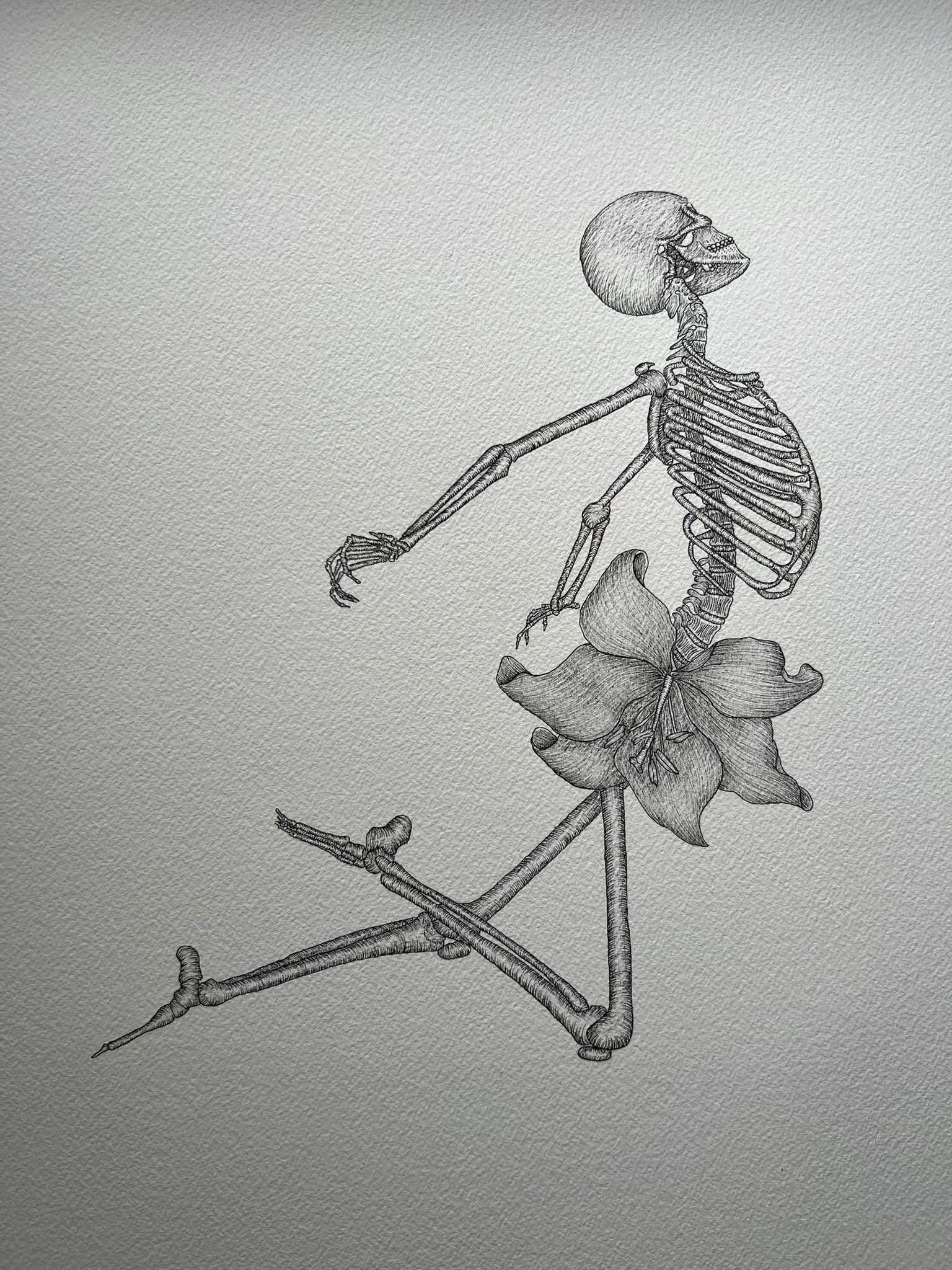
“Lilium" - 2023 - 14" x 17" - Ivana Tarraza - Ink on Arches Paper
On paper, Ivana could have easily become a casualty of the high-speed corporate engine. Graduating Magna Cum Laude in fashion design, she spent years in Miami producing massive runway shows for New York and London Fashion Weeks, working with heavy-hitting houses like Roberto Cavalli. She knows the intoxicating, exhausting rhythm of the modern hustle. Today, however, her day-to-day happens in Madrid: she teaches English to pay the bills, and paints to keep herself alive.
When I asked her the classic question of how she manages the internal “switch” between Ivana the teacher and Ivana the artist, she looked at me and gently dismantled the entire premise of the divided life:
“I don’t feel like there are two separate versions of me, nor an exact transition where the teacher disappears to make room for the artist. You reach a point where you start seeing the world through a different sensitivity, and that way of perceiving things filters into everything you do, even in the most everyday spaces.
Teaching, for instance, has something deeply creative to it: the way you connect with people, how you communicate ideas, how you read the energy of a room. My artistic side isn't just present when I’m painting; it is there in how I observe, how I listen, and how I interpret the world throughout the day. Rather than doing a ‘switch,’ I’ve learned to reconcile both parts. One feeds the other.”
That answer stopped me in my tracks. Those of us living the high-performing professional loop tend to view our passions as a fragile separate entity—a pet we leave locked in the apartment while we go out to do "real work." Ivana views it as the atmosphere she breathes.
Moving across the Atlantic forced her to recalibrate the very metric of human triumph. In Miami, success was a stopwatch; in Madrid, it became an anchor:
“When I worked in the fashion industry in Miami, success was heavily tied to a fast pace—to constantly producing, connecting, and hitting external goals. Everything was measured by the next project. Today, I view it in a much more human, sustainable way. Of course financial stability matters, especially when you emigrate and have to build a life from scratch, but it is no longer the only thing that defines whether I feel successful.
For me today, success means having peace of mind. It means feeling aligned with what I do, being able to create without feeling like I’m constantly just surviving, and building a life that doesn't force me to disconnect from myself to sustain it.”
A life that doesn't force me to disconnect from myself to sustain it. Read that sentence twice. If you are reading this from an office in Zurich, Geneva, or London, ask yourself how much of your daily bandwidth is spent doing precisely that.
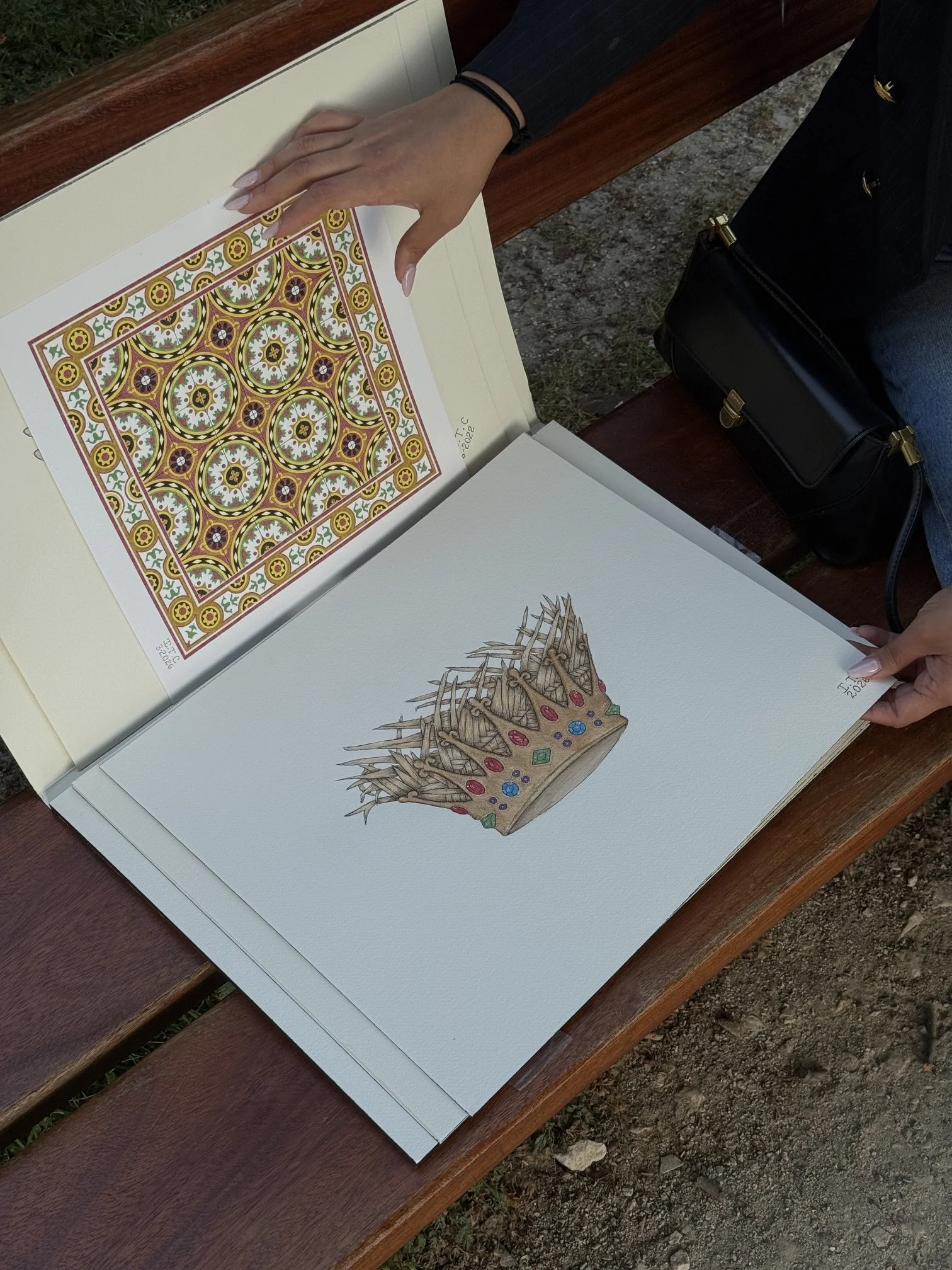
For the expatriate, distance does something magical to memory: it turns nostalgia into a compass. In one of Ivana’s most powerful pieces, she draws a regal skeleton wearing a Pava—the humble, traditional straw hat of the Puerto Rican rural farmworker—topped with a majestic crown. It is a visual manifesto born from wandering the halls of the Prado Museum:
“Living far from Puerto Rico made me much more aware of the cultural details I took for granted growing up. Seeing those patterns from a distance made me appreciate them as fragments of memory, architecture, and heritage. The crown comes from wanting to give that symbol a new meaning from a place of pride; to elevate something often viewed as simple or folkloric and present it as an emblem of dignity.
When you are far away, certain symbols stop being just cultural objects and become emotional reminders of who you are. That piece is about carrying your roots with you, and treating them not as something small, but as something worthy of taking up space.”
Ivana Tarraza
https://ivanatarraza.com
Naturally, living this way requires a deposit. You cannot buy creative sovereignty with the currency of absolute, guaranteed safety. When I asked her what her ultimate "non-negotiable" was, her response offered no cheap romanticism—only the grounded courage of someone who knows what things cost:
“My biggest non-negotiable is not sacrificing my creative authenticity to fit into a more commercial or comfortable version of what I do. If there is one thing I’d be willing to give up, it is that rigid idea of safety that so often chokes freedom.
I’d rather build a life that is perhaps less conventional, but where I have the room to create, experiment, and evolve, than live completely secure while feeling empty or stagnant. When you’ve rebuilt your life from scratch in another country, you understand that uncertainty can be deeply uncomfortable, but also profoundly transformative. Art lives right there: in that space between the uncertain and the authentic.”
III. The Quiet Rebellion
In a world obsessed with output, sitting down to draw a fern over a collarbone for four hours without knowing if anyone will ever buy it is not a hobby. It is an act of quiet, stubborn subversion. As Ivana put it before we parted ways:
“We live in a culture that values hyper-productivity—always doing, always available, always moving forward. The act of stopping to create purely from intuition, without a rush or an immediate performance goal, is in itself a form of rebellion.”
Walking away from our meeting that day, the noise in my own head had settled. I realized that my issue with this website wasn't a lack of time; it was that I had allowed the hyper-rational, risk-averse manager inside my brain to take the wheel away from the gut.
We are taught to fear the gut feeling. We treat it like an eccentric, unreliable friend who might convince us to quit our jobs and move to a forest. But the inner call isn't an agent of chaos; it is an agent of preservation. It is the voice that reminds you that you are a complex, multi-layered human being, not an economic unit.
You do not have to blow up your life to honor your spark. You don't have to choose between being a sharp, effective professional and being a passionate creator. You simply have to stop using your intellect to negotiate against your own soul. The spark inside you hasn't burnt out; it is just waiting for the room to get quiet enough for you to notice it again.
Open the window. Let the botany grow over the scaffolding. And turn the volume back up.
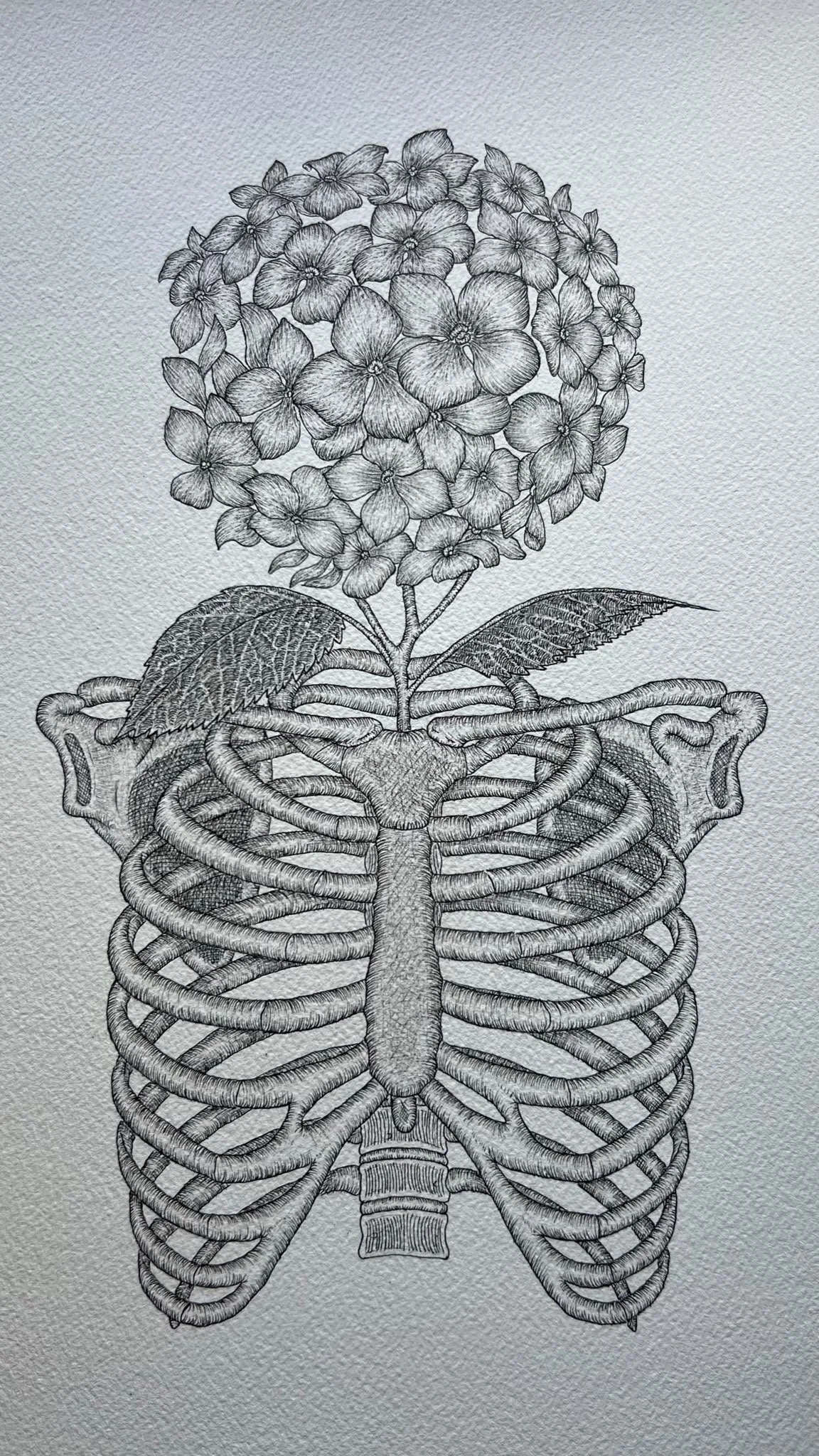
“Hortensia” - 2023 - Ivana Tarraza
